
Thank you! Your submission has been received!
Oops! Something went wrong while submitting the form.
2026
-
AACR
-
H-Optimus-1: A foundation model for computational histopathology
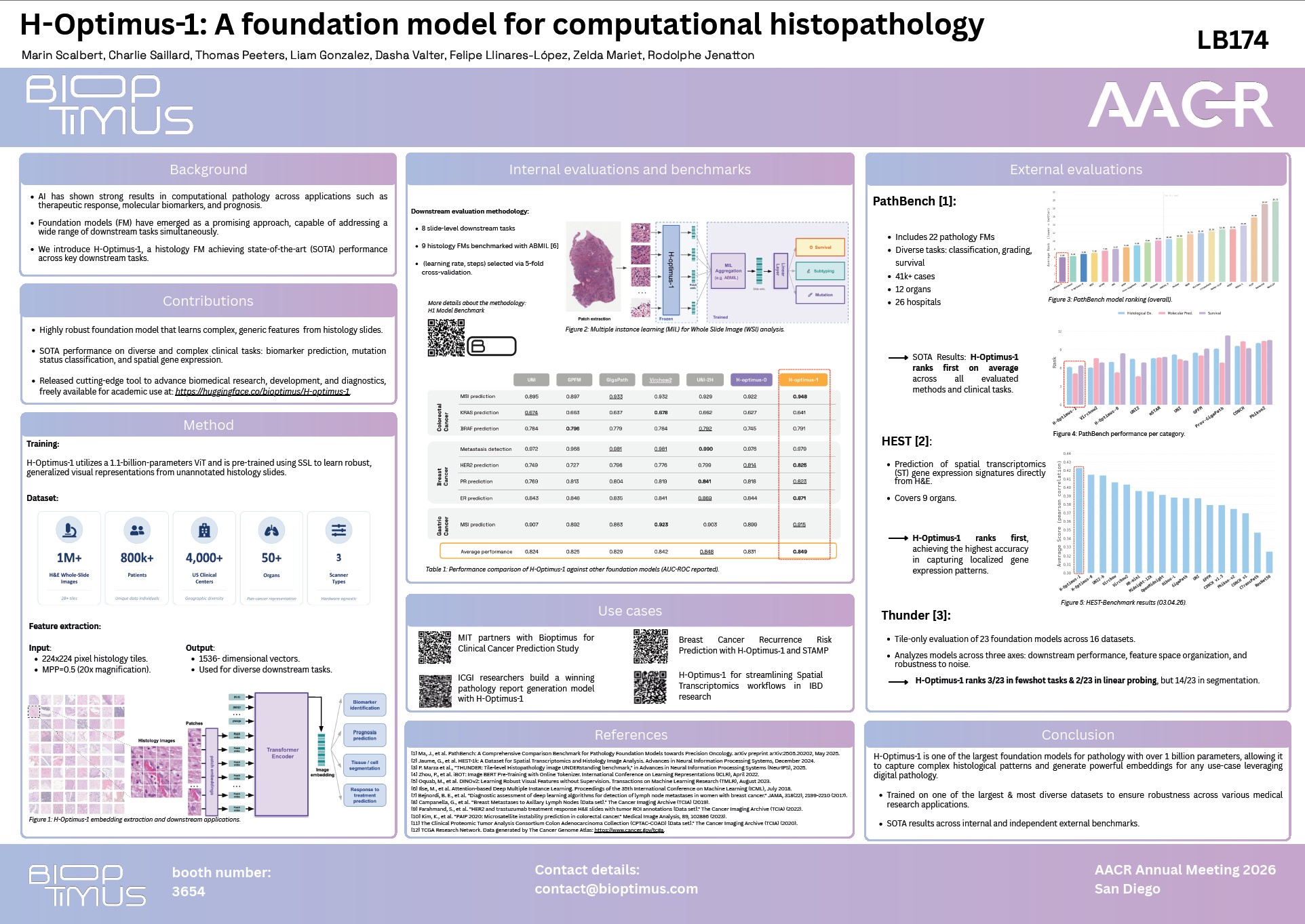
Pathology AI usually needs a different model for every task. H-Optimus-1 is one model with 1.1B parameters, trained on one of the largest histology datasets. It is hitting state-of-the-art across major external benchmarks.
Download PDF
Model:
H-Optimus
Topics:
Bioptimus Research
2024
-
GitHub / bioRxiv
-
H-optimus-0: A Foundation Model for Computational Pathology
H-optimus-0 is Bioptimus's inaugural open-source pathology foundation model — a 1.1B-parameter ViT-g/14 trained with self-supervised learning on over 500,000 whole-slide images from 4,000+ clinical centers worldwide. The model achieves state-of-the-art performance across tile- and slide-level benchmarks including cancer subtyping, biomarker prediction, and gene expression estimation. As the foundational release of Bioptimus's model family, H-optimus-0 has exceeded one million downloads and is widely adopted by pharmaceutical and academic researchers.
Read full publication
Model:
H-Optimus
Topics:
Bioptimus Research
Foundation Models for Computational Pathology
2026
-
Bioengineering (MDPI)
-
Pathology Foundation Models: Evolution, Current Landscape, Challenges and Opportunities from a Technical and Clinical Perspective
This peer-reviewed review surveys the technical and clinical evolution of pathology foundation models, from early task-specific systems to large Vision Transformer architectures trained on millions of slides. H-optimus-0 and H-optimus-1 are cited as leading examples of domain-specific pathology foundation models representing best-in-class scale and performance. The work places Bioptimus at the forefront of a rapidly maturing field with clear clinical translational potential.
Read full publication
Model:
H-Optimus
Topics:
Foundation Models for Computational Pathology
Bioptimus Research
2024
-
NeurIPS 2024 (Spotlight)
-
HEST-1k: A Dataset for Spatial Transcriptomics and Histology Image Analysis
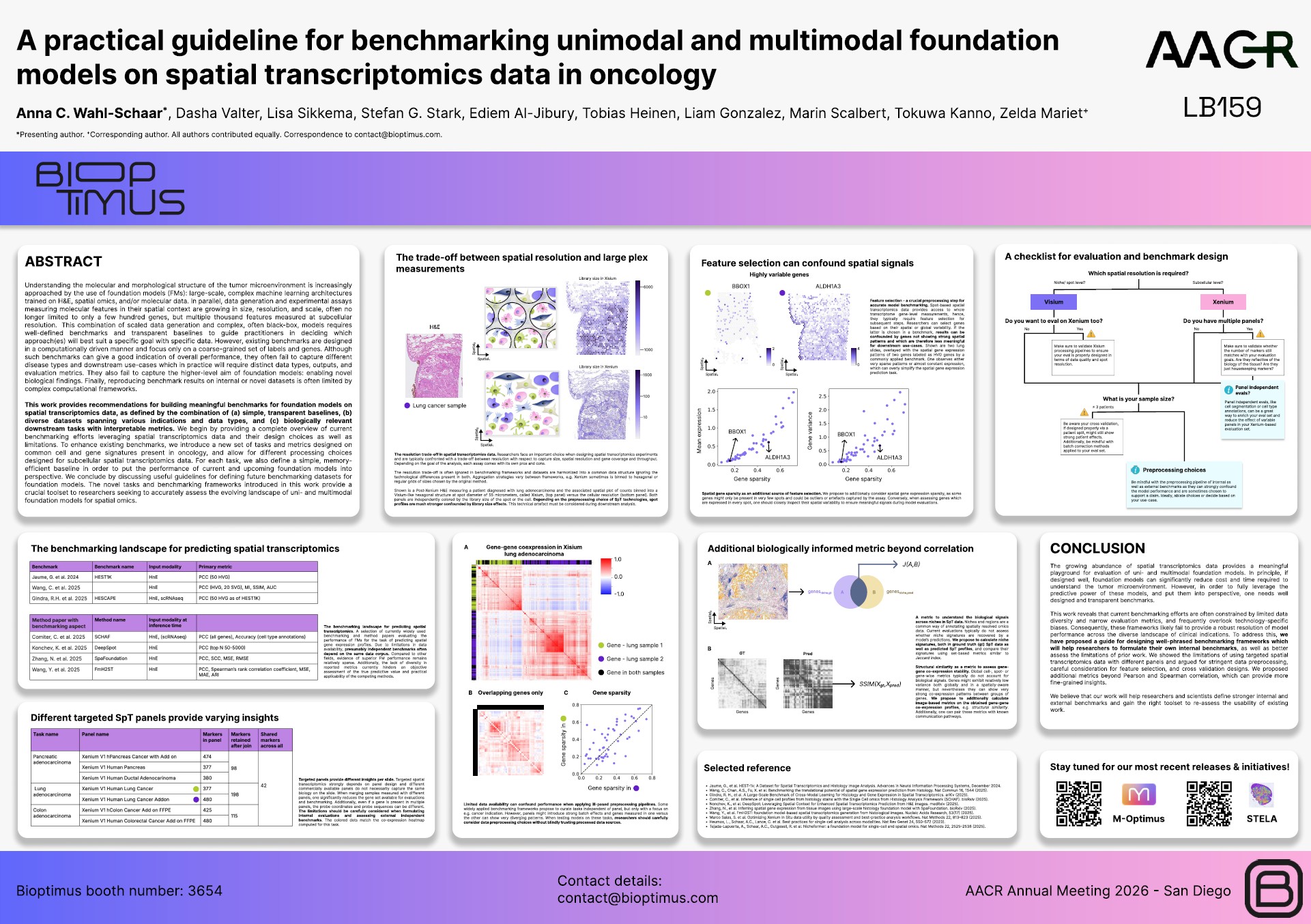
HEST-1k assembles 1,229 spatial transcriptomic profiles each paired with a whole-slide image and metadata across 26 organs and 25 cancer types, providing a large benchmark for foundation model evaluation in spatial biology. H-optimus-0 achieves top performance on the HEST-Benchmark for predicting spatial gene expression directly from H&E images, ranking first among all evaluated foundation models. The work establishes HEST as the primary benchmark for evaluating pathology models on spatial transcriptomics — a domain central to Bioptimus's M-Optimus and STELA platforms.
Read full publication
Model:
H-Optimus
Topics:
Foundation Models for Computational Pathology
Bioptimus Research
2025
-
Computers in Biology and Medicine
-
A Lightweight and Extensible Cell Segmentation and Classification Model for Whole Slide Images
This paper develops a lightweight, deployable cell segmentation and classification model for whole slide images using H-optimus-0 as a fixed encoder backbone integrated with a U-Net architecture. By cross-relabeling PanNuke and MoNuSAC annotations to create a unified seven-class dataset and distilling the H-optimus-0-based model, the authors achieve a 48× reduction in parameters while maintaining segmentation quality. The distilled model is integrated into QuPath, bringing Bioptimus-quality feature extraction to clinical digital pathology workflows.
Read full publication
Model:
H-Optimus
Topics:
Foundation Models for Computational Pathology
Oncology Applications
2026
-
Computers in Biology and Medicine
-
MIPHEI-ViT: Multiplex Immunofluorescence Prediction from H&E Images using ViT Foundation Models
MIPHEI-ViT predicts multiplex immunofluorescence signals from routine H&E images using a U-Net architecture with H-optimus-0 as the encoder backbone, enabling cell-type characterization without requiring expensive mIF panels. Trained on the OrionCRC dataset and validated across five independent cohorts, the model achieves strong performance for key immune and stromal markers including T cells, B cells, and epithelial markers. The work demonstrates H-optimus-0's effectiveness as a general-purpose encoder for translating between complementary tissue analysis modalities.
Read full publication
Model:
H-Optimus
Topics:
Foundation Models for Computational Pathology
Oncology Applications
2025
-
ESMO Real World Data and Digital Oncology
-
End-to-end deep learning for predicting breast cancer recurrence risk
This study presents an end-to-end deep learning framework for predicting breast cancer recurrence risk directly from whole-slide images, benchmarking multiple pathology foundation models in a clinical oncology setting. H-optimus-1 achieves top performance among all evaluated models, providing the strongest predictive signal for recurrence risk stratification. Published in ESMO Real World Data and Digital Oncology, the work delivers high-profile clinical validation of H-optimus-1's translational value in breast cancer prognosis.
Read full publication
Model:
H-Optimus
Topics:
Oncology Applications
Foundation Models for Computational Pathology
2025
-
arXiv:2509.09923 (preprint)
-
Engineering Spatial and Molecular Features from Cellular Niches to Inform Predictions of Inflammatory Bowel Disease
This paper presents a computational framework that utilizes spatial transcriptomics to distinguish between Crohn's disease, ulcerative colitis, and healthy tissue. The authors use H-optimus-1 to predict spatial gene expression directly from routine H&E-stained slides, enabling more efficient identification of high-value tissue regions for further analysis. This integration provides an accurate and explainable tool for understanding the spatial organization of IBD pathology.
Read full publication
Model:
H-Optimus
Topics:
Spatial Biology & Transcriptomics
Oncology Applications
2025
-
medRxiv (preprint)
-
Uncertainty-Aware Prediction of Microsatellite Instability in Colorectal Cancer from H&E-Stained Whole Slide Images
This study develops an uncertainty-aware deep learning pipeline for predicting microsatellite instability (MSI-H) status directly from H&E-stained colorectal cancer whole slide images. H-optimus-0 is used for tissue patch encoding within the prediction framework. The approach advances clinically actionable biomarker prediction by incorporating calibrated uncertainty estimates alongside MSI predictions.
Read full publication
Model:
H-Optimus
Topics:
Biomarker Detection & Treatment Response
Oncology Applications
2025
-
arXiv (preprint)
-
PathBench: A Comprehensive Comparison Benchmark for Pathology Foundation Models Towards Precision Oncology
PathBench is the most comprehensive pathology foundation model benchmark to date, evaluating 19 models on 15,888 whole-slide images from 8,549 patients across 10 hospitals and 64 diagnosis and prognosis tasks in common cancer types. H-optimus-1 achieves the best overall average ranking score (2.3), ranking first in lung and colorectal cancer tasks, and H-optimus-0 excels in molecular subtyping. This benchmark is the most rigorous public validation of Bioptimus models' superiority across the full clinical spectrum from diagnosis to prognosis.
Read full publication
Model:
H-Optimus
Topics:
Foundation Models for Computational Pathology
Oncology Applications
2025
-
arXiv:2508.04441 (preprint)
-
Benchmarking Foundation Models for Mitotic Figure Classification
A comprehensive benchmark evaluating multiple pathology foundation models for mitotic figure classification in histopathology slides. H-optimus-0 and H-optimus-1 rank among the strongest models evaluated across multiple datasets. This work confirms the Bioptimus model family's capability for cell-level detection tasks critical for cancer grading and prognostication.
Read full publication
Model:
H-Optimus
Topics:
Foundation Models for Computational Pathology
Oncology Applications
2025
-
arXiv:2506.09095 (preprint)
-
Foundation Models in Medical Imaging: A Review and Outlook
This comprehensive review surveys the landscape of foundation models across medical imaging modalities, with substantial coverage of computational pathology. H-optimus-0 and H-optimus-mini are highlighted as leading examples of domain-specific pathology foundation models representing the state of the art. The work positions Bioptimus firmly within the broader medical AI research community.
Read full publication
Model:
H-Optimus
Topics:
Foundation Models for Computational Pathology
2025
-
MICCAI 2025
-
Distilling Foundation Models for Robust and Efficient Models in Digital Pathology
This paper demonstrates that H-optimus-0 can serve as an effective teacher model for knowledge distillation, yielding a compact student model (H0-mini) that achieves comparable downstream performance at significantly reduced computational cost. The distilled model achieves 3rd place on the HEST benchmark and outstanding robustness to staining and scanning variation. This work showcases the transferability and practical deployability of Bioptimus's foundation model architecture.
Read full publication
Model:
H-Optimus
Topics:
Foundation Models for Computational Pathology
2025
-
Nature Communications
-
A Clinical Benchmark of Public Self-Supervised Pathology Foundation Models
This study establishes a benchmark of publicly available self-supervised pathology foundation models evaluated on six clinically relevant tasks spanning multiple organs and disease types, using slides from three medical centers. H-optimus-0 ranks among the top three models — alongside Prov-GigaPath and SP85M — achieving the highest average AUC (0.785) on biomarker prediction tasks, outperforming UNI and Phikon. The work provides direct evidence of H-optimus-0's competitive standing against all publicly available pathology AI models.
Read full publication
Model:
H-Optimus
Topics:
Foundation Models for Computational Pathology
Oncology Applications
2025
-
npj Precision Oncology
-
A Comprehensive Evaluation of Histopathology Foundation Models for Ovarian Cancer Subtype Classification
This rigorous study evaluates 14 histopathology foundation models for five-class ovarian carcinoma subtype classification, trained on 1,864 whole-slide images and validated across two independent external cohorts. H-optimus-0 achieves the highest balanced accuracy — 89% internal, 97% and 74% external — ranking as the best-performing model overall. The results provide compelling clinical-grade evidence for deploying Bioptimus's models in rare and complex cancer diagnostics.
Read full publication
Model:
H-Optimus
Topics:
Oncology Applications
Foundation Models for Computational Pathology
2025
-
MICCAI 2025
-
Teaching Pathology Foundation Models to Accurately Predict Gene Expression with Parameter Efficient Knowledge Transfer
This paper presents a parameter-efficient fine-tuning approach for adapting pathology foundation models — including H-optimus — to the task of predicting spatial gene expression directly from histology images. The method achieves competitive gene expression prediction performance with minimal additional training cost, making it highly practical for spatial biology applications. The work demonstrates the adaptability of Bioptimus models to the multi-omic data integration central to the M-Optimus and STELA roadmap.
Read full publication
Model:
H-Optimus
Topics:
Spatial Biology & Transcriptomics
Foundation Models for Computational Pathology
2025
-
Computers in Biology and Medicine
-
From Histology to Diagnosis: Leveraging Pathology Foundation Models for Glioma Classification
This paper applies pathology foundation models to glioma classification from H&E-stained whole slide images, evaluating their ability to distinguish tumor grades and molecular subtypes. H-optimus-0 achieves strong classification performance, and knowledge distillation from H-optimus-0 further improves results for this domain-specific brain tumor task. The work demonstrates Bioptimus models' effectiveness for rare and complex neurological tumor diagnostics.
Read full publication
Model:
H-Optimus
Topics:
Oncology Applications
Foundation Models for Computational Pathology