
LAUNCH Q1/2026

Introducing

We believe the solutions to the world’s toughest diseases exist  — hidden in plain sight, but obscured by noise and locked in siloed biological data.

Operating on this simple belief, Bioptimus built the world’s most powerful Foundation Model of Biology:

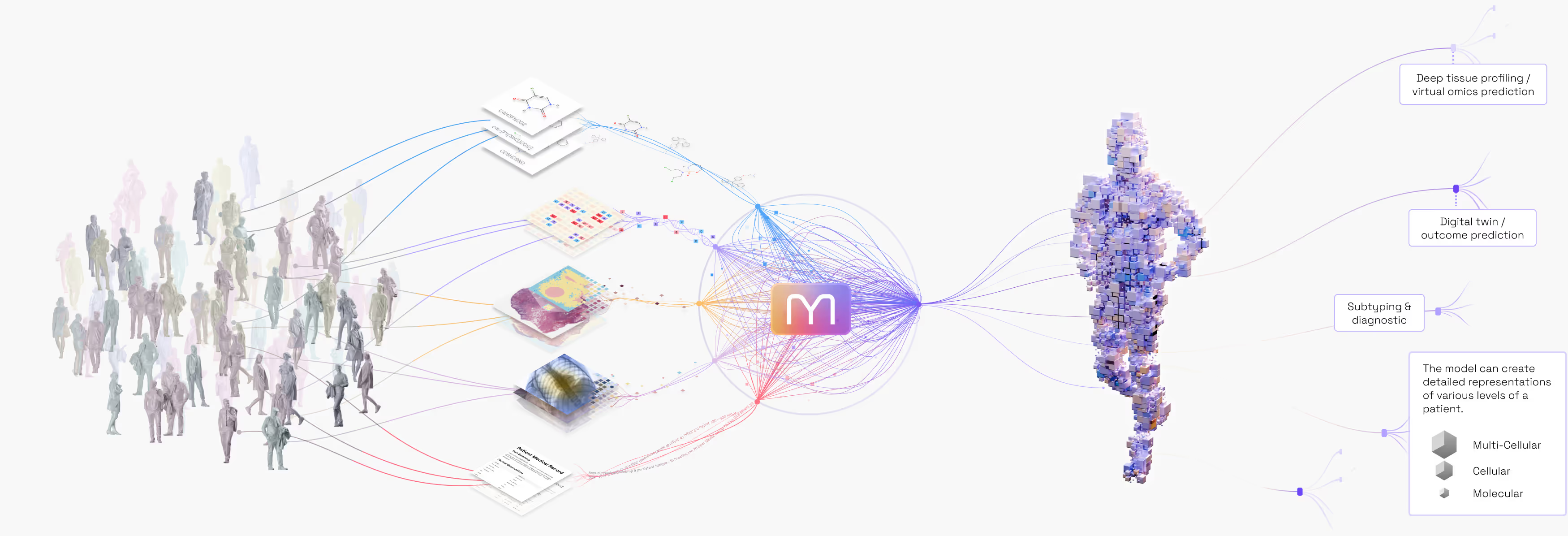
Create a digital twin of every patient.

Leverage the complexities of the interplay of biological scales.

Utilize M-Optimus multi-modal embeddings to accelerate your work.

Our World Foundation Model of Biology will show you more than 
you could ever imagine.

predict clinical outcomes

predict gene mutations

predict key gene expression markers

infer cell composition

Using -Optimus you can predict missing data modalities and fill in the missing information across modalities in silico.

The World Model of Biology is on the horizon.

We believe the solutions to the world’s toughest diseases exist and are hidden in plain sight – locked in silos and obscured by the noise of biological data.


M-Optimus, built on billions of data points, enables users to mine, interrogate and model experimental outcomes in silico, guiding them to new targets, signatures and precision solutions. More than an innovation, M-Optimus is the first step in leading an AI revolution in healthcare, where simple routine bedside tests can drive treatment decisions. Unlocking not only access to potentially lifesaving therapies for patients, but also greater access to qualified patients for clinical trials.

Be one of the first to experience M-Optimus
-Optimus is trained on millions of patients’ data already.

M‑Optimus is trained on a large, proprietary corpus spanning billions of data points, from millions of patients and hundreds of institutions. It unifies routine Hematoxylin and Eosin (H&E) slides with multi‑omics profiles, in both spatially and non-spatially resolved tissues, with longitudinal clinical outcomes.

For clinical development, this breadth and diversity matter: they help the model learn stable, cross‑scale biology, without introducing trial or cohort‑specific artifacts.

For researchers, M-Optimus allows you to quickly develop AI embeddings of your specific patients of interest and to refine and tune the model for more complete insights.

For target hunters, LLM or AI agents can be deployed to "deep mine" the composite model for novel insights, new targets and for the development of data-driven combination strategies.

Trained on diverse multi-modal patient cohorts.

Unlike most other foundation models used in healthcare, M-Optimus is a multimodal, multiscale foundation model that offers a new path toward a unified representation of a patient across tissue, molecular, and clinical levels.
M-Optimus operates like the lens of a camera allowing you to zoom into the molecular details and out to their clinical significance across populations.

Designed to de‑risk trials and clarify decisions.

By generating in‑silico readouts from existing data and linking them to clinical outcomes, M‑Optimus helps you:

  • Design smarter inclusion and stratification strategies
  • Identify and validate biomarkers earlier
  • Prioritize indications and combinations with higher confidence

The result is fewer blind spots in trial design, more informative data per patient, and a clearer path to decisive development milestones.

The most valuable commodity in drug development is certainty.

M-Optimus shifts the paradigm from hypothesis-driven high-risk investments to data driven high-confidence decision making. 
M-Optimus will deliver the power to de-risk pipelines, accelerate time-to-market, and may unlock new markets with new therapeutic indications. Opening possibilities to repurpose failed drugs, identify new candidate patients and accelerate timelines across the drug development timeline, generating savings and revenue potential in the billions.

Predict Gene and Protein Drug Targets

The Challenge
The Risk
The Reward

Actionable Biomarkers are undiscovered:
Tissue is a precious and a limited commodity for each patient. Mutation status often depends on expensive, slow genetic sequencing, which is not routinely available or technically feasible for every patient.

Valuable molecular interactions and signatures are never seen:
At the population scale, experimental biomarkers are not always included in multi-gene biomarker panels, so they remain hidden in the biological noise. For translational and target discovery researchers, it's difficult to know where to invest and which indications to select for promising targets.

Building research on top of M-Optimus's powerful foundation:
Build your own embeddings using M-Optimus and explore them within the context of thousands of other similar patients. Or fine tune the foundation model, predicting gene mutations and protein expression from multimodal embeddings of H&E or routine sequencing.  Use M-Optimus as a deep mining tool to identify new connections and new molecular signatures.
Actionable Biomarkers are undiscovered:
Tissue is a precious and a limited commodity for each patient. Mutation status often depends on expensive, slow genetic sequencing, which is not routinely available or technically feasible for every patient.

Valuable molecular interactions and signatures are never seen:
At the population scale, experimental biomarkers are not always included in multi-gene biomarker panels, so they remain hidden in the biological noise. For translational and target discovery researchers, it's difficult to know where to invest and which indications to select for promising targets.

Building research on top of M-Optimus's powerful foundation:
Build your own embeddings using M-Optimus and explore them within the context of thousands of other similar patients. Or fine tune the foundation model, predicting gene mutations and protein expression from multimodal embeddings of H&E or routine sequencing.  Use M-Optimus as a deep mining tool to identify new connections and new molecular signatures.

Predict Clinical Outcomes

The Challenge
The Risk
The Reward

Access to Patients:
Trial identification requires costly diagnostics, and with the uncertainty of each patient's suitability for inclusion (presence of biomarkers), these costly molecular tests have to be performed on all-comers. This creates delays, extends timelines, encourages high competition for patient enrollment, and ultimately does not derisk failing to meet the endpoints, or risks under recruitment for clinical trials.

Access to Patients:
Trial identification requires costly diagnostics, and with the uncertainty of each patient’s suitability for inclusion (presence of biomarkers), these costly molecular tests have to be performed on all-comers. This creates delays, extends timelines, encourages high competition for patient enrollment, and ultimately does not derisk failing to meet the endpoints, or risks under recruitment for trials.

Identify The Right Patients for Trial and Model Patients in silico:
Leverage M-Optimus multimodal embeddings (H&E slide + bulk or spatial transcriptomics) to predict outcomes like Objective Response Rate (ORR) and Progression-Free Survival (PFS) and to identify qualifying patients from larger cohorts of candidates with only routing diagnostics available. Use existing clinical data to power synthetic clinical trial arms, for pharma research providing more trial design flexibility and better use of rare patients. For the physician, M-Optimus may assist with predicting precision therapies at the bedside.

Fragmented Insights:
Clinical decisions rely on incomplete, siloed data across histology, gene expression, and other biomarkers, making outcome prediction weak, cohort design guesswork, and recruitment slow.

Access to Patients:
Trial identification requires costly diagnostics, and with the uncertainty of each patient's suitability for inclusion (presence of biomarkers), these costly molecular tests have to be performed on all-comers. This creates delays, extends timelines, encourages high competition for patient enrollment, and ultimately does not derisk failing to meet the endpoints, or risks under recruitment for clinical trials.

Identify The Right Patients for Trial and Model Patients in silico:
Leverage M-Optimus multimodal embeddings (H&E slide + bulk or spatial transcriptomics) to predict outcomes like Objective Response Rate (ORR) and Progression-Free Survival (PFS) and to identify qualifying patients from larger cohorts of candidates with only routing diagnostics available. Use existing clinical data to power synthetic clinical trial arms for pharma research, providing more trial design flexibility and better use of rare patients. For the physician, M-Optimus may assist with predicting precision therapies at the bedside.

Predict Spatial Gene and Protein expression.

The Challenge
The Risk
The Reward

Quality patients for Precision Medicine aren't found:
Tests for spatial gene and protein biomarkers are expensive and not routinely performed, making patient identification slow and costly.

The Costs are Staggering:
Every day in clinical development costs $1M on average. Identifying and enrolling patients for precision medicine trials require additional costly biomarker tests, slowing trials and missing patients that could benefit from treatment.

M-Optimus may fill in the missing information:
By predicting qualifying gene and protein markers directly from routine H&E, M-Optimus lowers the thresholds to patient qualification. And for the drug discovery and early clinical researchers, M-Optimus explains the biological mechanisms that underpin response.

Quality patients for Precision Medicine aren't found:
Tests for spatial gene and protein biomarkers are expensive and not routinely performed, making patient identification slow and costly.

The Costs are Staggering:
Every day in clinical development costs $1M on average. Identifying and enrolling patients for precision medicine trials require additional costly biomarker tests, slowing trials and missing patients that could benefit from treatment.

M-Optimus may fill in the missing information:
By predicting qualifying gene and protein markers directly from routine H&E, M-Optimus lowers the thresholds to patient qualification. And for the drug discovery and early clinical researchers, M-Optimus explains the biological mechanisms that underpin response.

Understand Complex Cell Compositions & Cellular Dependencies

The Challenge
The Risk
The Reward

Every patient has a unique disease and a unique immune system:
Cellular complexity and interdependencies are not well interrogated from routine laboratory tests.

M-Optimus elucidates cellular interdependencies:
Patients receive more effective treatments, and are excluded from potentially toxic treatments, and treatments that have a poor predictive outcome based on their unique cellular composition. Patients with actionable biomarkers and favorable immune profiles receive the right therapy earlier in their treatment journey.

M-Optimus elucidates cellular interdependencies:
Patients receive more effective treatments, and are excluded from potentially toxic treatments, and treatments that have a poor predictive outcome based on their unique cellular composition. Patients with actionable biomarkers and favorable immune profiles receive the right therapy earlier in their treatment journey.

Every patient has a unique disease and a unique immune system:
Cellular complexity and interdependencies are not well interrogated from routine laboratory tests.

Incomplete information hinders patient outcomes:
You may miss key biomarkers and mechanisms of response, or toxicity, and you don't systematically enrich or exclude patients based on immune or stromal physiology.

M-Optimus elucidates cellular interdependencies:
Patients receive more effective treatments, and are excluded from potentially toxic treatments, and treatments that have a poor predictive outcome based on their unique cellular composition. Patients with actionable biomarkers and favorable immune profiles receive the right therapy earlier in their treatment journey.

Built to facilitate novel insights and better decision‑making

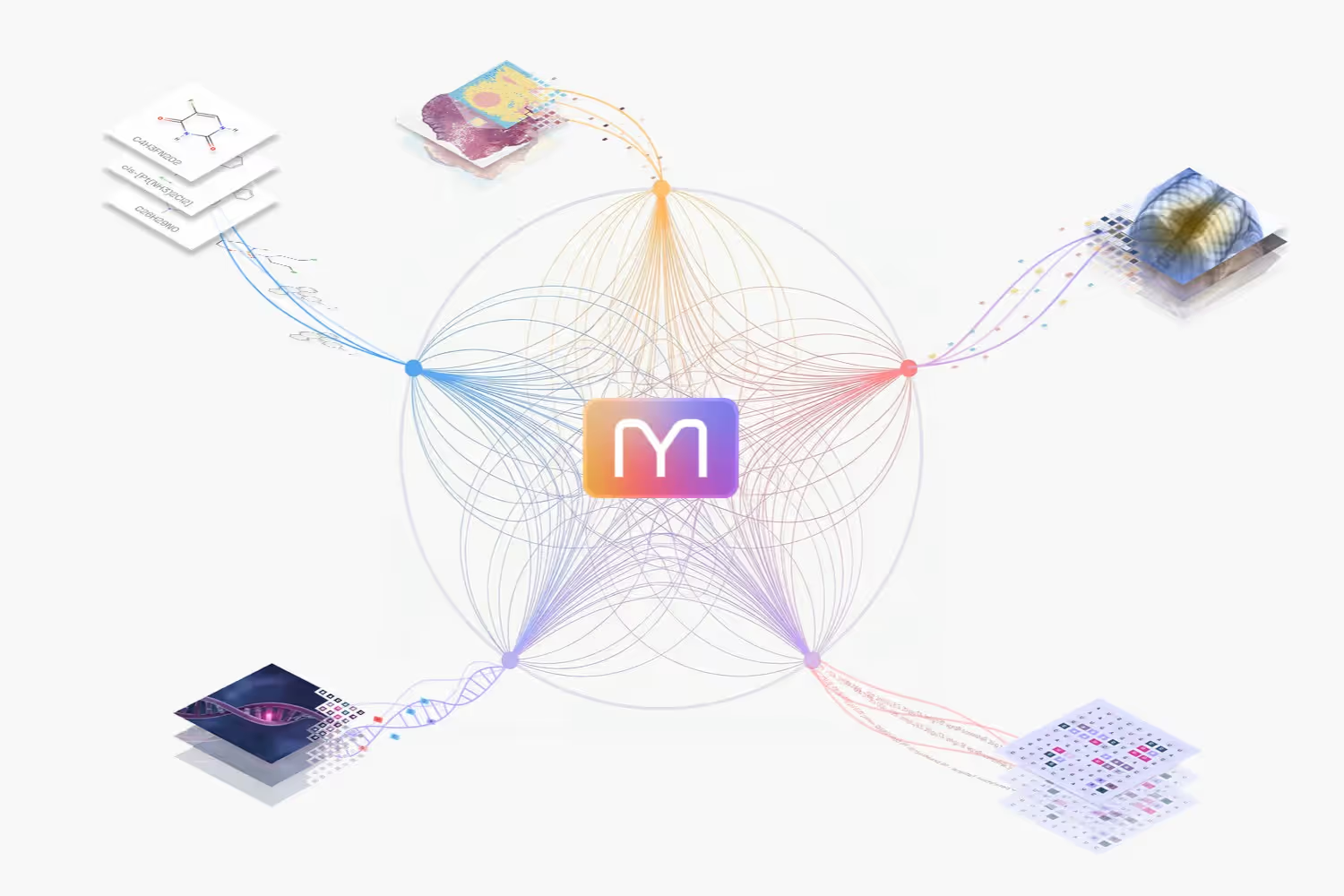
M-Optimus is the ultimate backbone for encoding and decoding biology. It leverages a cutting-edge neural network architecture that maps different data modalities into a unified representation.
The M-Optimus backbone thus acts as a powerful foundation for specialized prediction models in a plug-and-play fashion. This allows teams to reuse and repurpose M-Optimus for different tasks, typically with few available samples, without the need to train their own models from scratch.

Built by the team behind
benchmark‑leading pathology models.

Trusted by almost 1 Million professionals

M‑Optimus is developed by a team of veterans from frontier AI and biology labs that created the H‑Optimus histopathology foundation models, with nearly 1 Million downloads and consistent state‑of‑the‑art results in global benchmarks. The same scientific rigor and validation practices are present in M‑Optimus. For clinical leaders, this translates into a platform you can evaluate with the same standards you use for any critical decision‑support technology, rather than experimental models that are hard to trust at scale.

H-Optimus-1 is now available on Amazon SageMaker AI

Try H1
Tjalling Bosse
Professor Pathology at
Leiden University Medical Center.

“M-Optimus has the incredible potential to democratize treatment decisions for patients worldwide, by using inexpensive routine tests like H&E biopsies to gain complex molecular and phenotypic information, stratifying patients at the bedside, predicting their actionable biomarkers, and enabling physicians to make treatment decisions regarding which patients to give targeted therapies, and which patients to send home without aggressive treatments.

Building upon the capabilities of H-Optimus-1, the potential predictive power of M-Optimus is very exciting indeed.”

This is your chance to be at the forefront of a new era in biological insights.